
Polyvinyl Chloride (PVC) is one of the most widely used thermoplastics, valued for its versatility, durability, chemical resistance, and ability to be produced in both rigid and flexible forms. It is used in pipes, profiles, cables, flooring, packaging, sheets, medical products, footwear, and many other applications.
When PVC waste is recycled, it can be shredded and processed into PVC flakes. These flakes may contain different colors, shades, contaminants, and unwanted materials. Efficient sorting is important when recyclers need consistent and cleaner material for further processing.
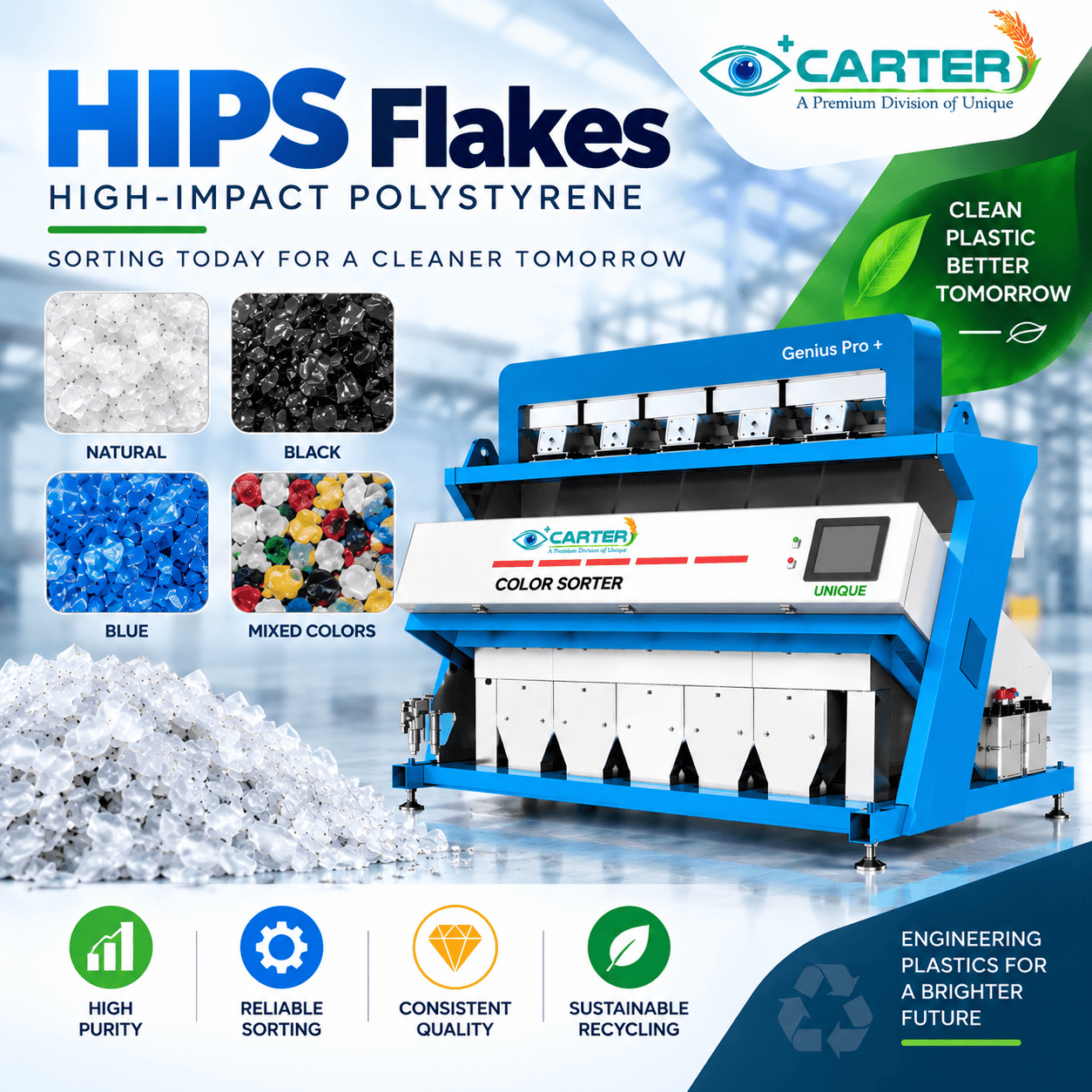
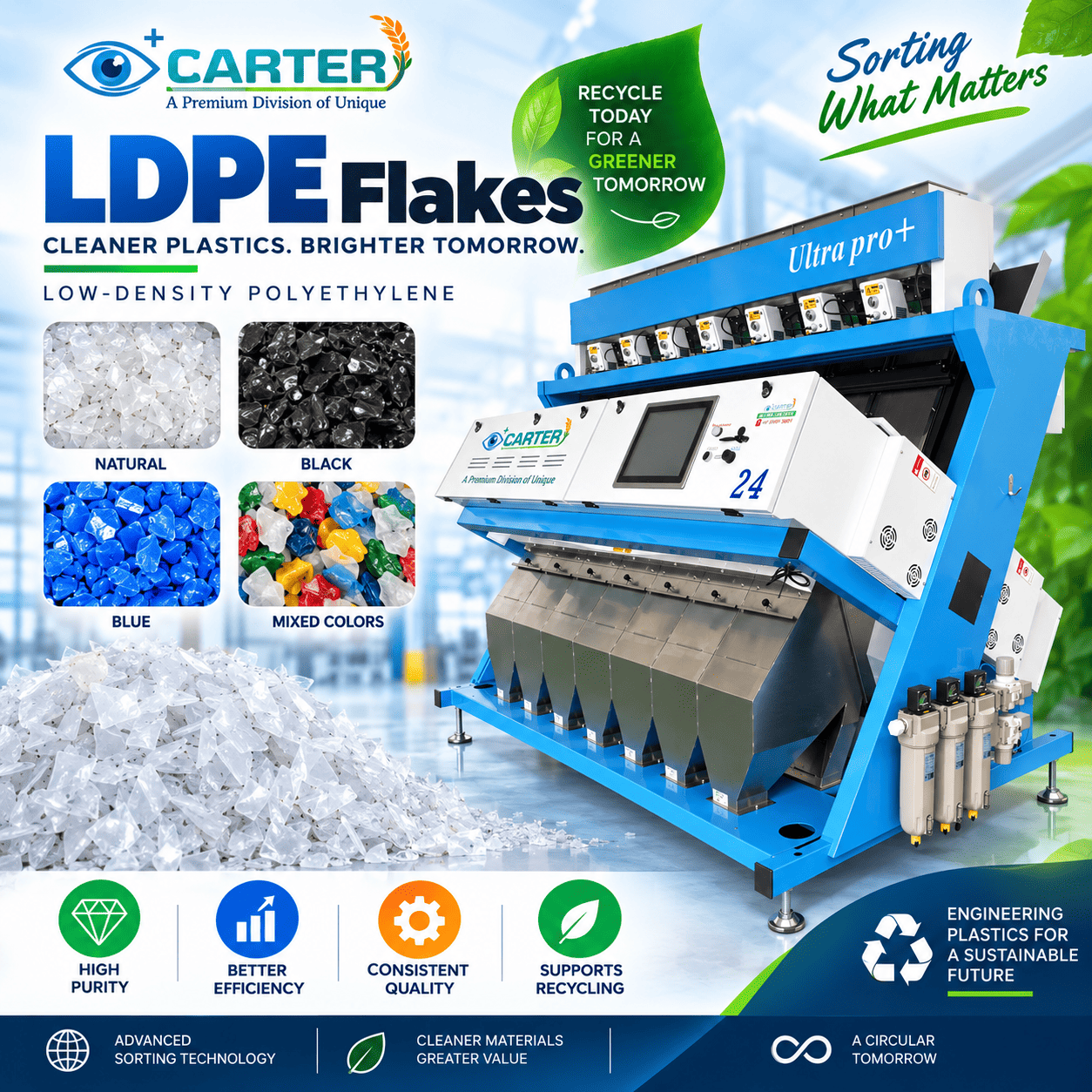
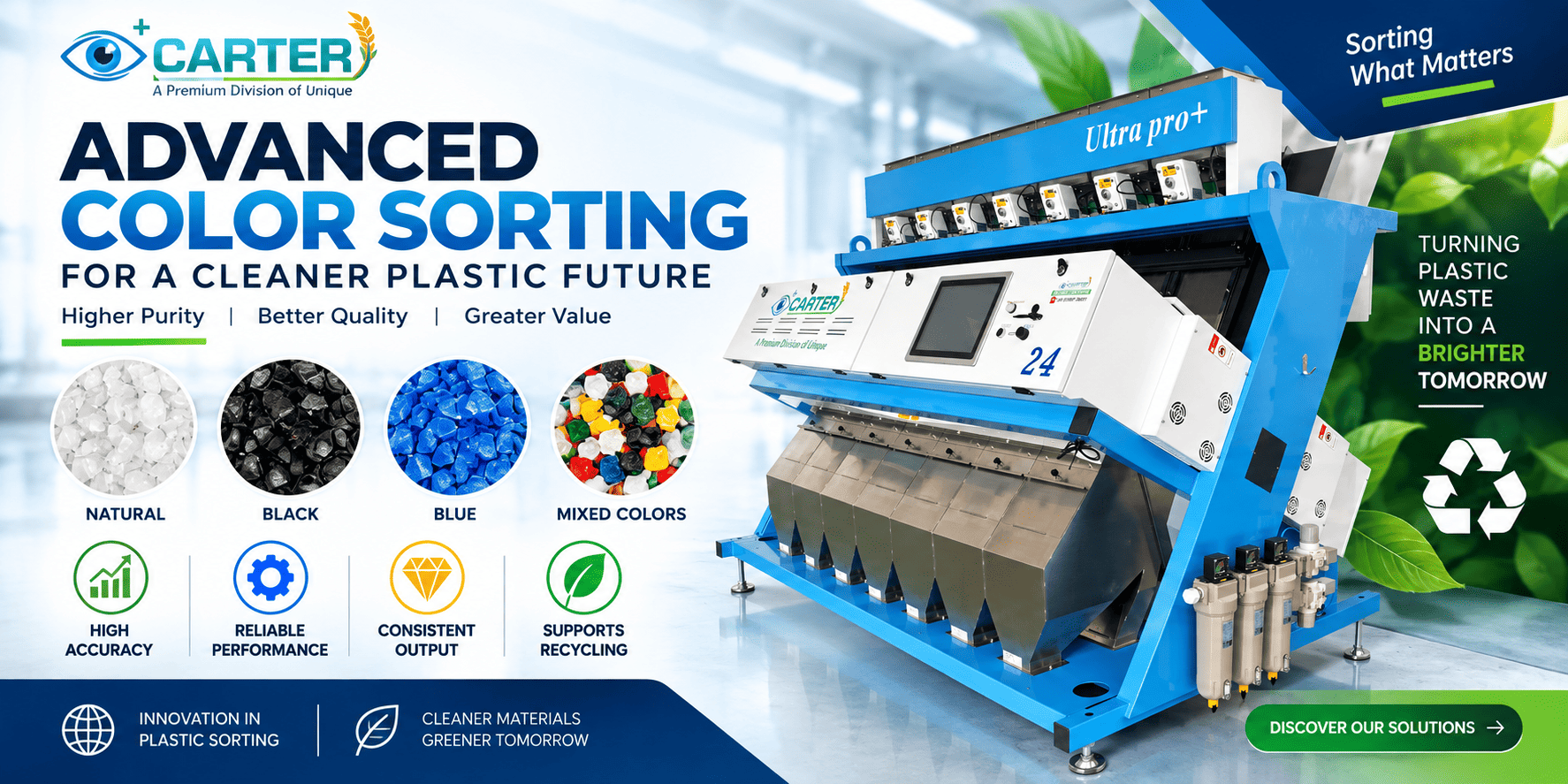
A PVC flakes color sorter machine can help automate color-based separation of PVC flakes using optical detection technology. By reducing repetitive manual sorting and providing continuous inspection, a plastic color sorter machine can support more efficient PVC recycling operations.
PVC flakes are small pieces of Polyvinyl Chloride obtained after PVC waste is processed through operations such as sorting, shredding, grinding, and screening.
PVC waste can come from many sources, including:
After processing, the resulting flakes can have different:
This variation makes sorting an important stage in many PVC recycling processes.
PVC is generally found in two major forms.
Rigid PVC, also called unplasticized PVC or uPVC, is stiff and durable.
Common applications include:
Flexible PVC is produced by incorporating plasticizers and is softer and more flexible than rigid PVC.
It is commonly used for:
The recycling characteristics of rigid and flexible PVC can differ, so material identification and appropriate processing are important.
PVC has several properties that have contributed to its widespread industrial use.
PVC products can provide good durability and resistance to many environmental conditions.
PVC generally offers useful resistance to many acids, alkalis, salts, and other chemicals, although compatibility depends on the specific formulation and conditions.
PVC can be formulated into rigid or flexible products for very different applications.
PVC is widely used for electrical cable insulation because of its useful electrical insulating properties.
PVC can be processed into various shapes and products using appropriate manufacturing technologies.
PVC is widely used in applications where a balance of performance and cost is required.
PVC is used across numerous industries.
PVC is widely used in:
Flexible PVC is commonly used for:
Selected PVC grades and products are used in:
PVC is used in certain:
PVC can also be found in:
Depending on their composition, cleanliness, color, and quality, recycled PVC flakes can be used as feedstock for further processing.
Potential applications include:
The actual end use depends on the properties and quality requirements of the recycled material.
PVC recycling streams can contain many different colors.
For example, a feedstock may contain:
White + Grey + Black + Blue + Green + Mixed Colors
If these materials are processed together, the resulting recycled PVC can have inconsistent visual characteristics.
Manual separation can be slow and labor-intensive, especially for high-volume recycling operations.
A PVC flakes color sorter machine can automate the separation of visually different flakes.
It can help recyclers:
A PVC flakes color sorter machine is an automated optical sorting system designed to detect and separate PVC flakes based on detectable color and optical characteristics.
A typical system can incorporate:
The basic operating principle is:
Feed → Detect → Analyze → Eject → Collect
As PVC flakes pass through the inspection area, the optical system detects differences in appearance. When a flake meets the programmed rejection criteria, a high-speed air jet can remove it from the main product stream.
Prepared PVC flakes enter the machine through a controlled feeding system.
Consistent feeding helps present the flakes properly to the optical inspection system.
The flakes move through a controlled sorting channel or chute.
Proper presentation is important because overlapping particles can make optical detection more difficult.
Cameras and sensors inspect individual flakes.
Depending on the machine configuration, detectable characteristics can include:
The machine's software analyzes the optical information and applies the selected sorting criteria.
When an unwanted flake is detected, the corresponding air ejector activates and removes the flake from the accepted material stream.
Accepted and rejected materials are directed into separate collection streams.
A typical PVC recycling line may include the following stages:
PVC Waste
↓
Pre-Sorting
↓
Shredding / Grinding
↓
Screening
↓
Washing Where Required
↓
Drying
↓
PVC Flakes
↓
Optical Color Sorting
↓
Sorted PVC Flakes
↓
Further Processing
The actual process depends on the source material and the desired recycled PVC quality.
A color sorter can automate repetitive visual sorting tasks.
Different color fractions can be separated when the optical contrast is sufficient.
The system can inspect material continuously as flakes pass through the sorting zone.
Automation can reduce the amount of repetitive manual sorting required.
Separating visually different material can help create more uniform fractions for downstream processing.
The machine can be configured according to the specific characteristics and sorting objectives of the PVC material.
Automated sorting can become an important stage in a modern plastic recycling line.
This distinction is particularly important when recycling PVC.
A color sorter machine is primarily designed to identify detectable optical differences.
It can therefore be useful for separating:
However, color sorting does not automatically identify the polymer type.
For example, PVC flakes can visually resemble flakes made from other polymers. Similarly, different PVC formulations may look alike.
If the recycling objective involves identifying PVC based on polymer chemistry rather than color, additional material-identification technologies may be required.
Proper preparation can contribute to stable optical sorting.
A suitable and reasonably consistent particle-size range helps improve material presentation.
If PVC flakes are washed, appropriate drying may be necessary before optical sorting.
Excessive dust can affect the sorting environment and optical inspection.
Dirty or heavily contaminated flakes can make optical detection more challenging.
Material should be presented so that individual flakes can be inspected effectively.
Metal, paper, rubber, labels, and other contaminants may require separate separation technologies.
Selecting a PVC flakes color sorter machine should begin with an assessment of the actual feed material.
Determine whether the material comes from:
The size distribution of the flakes should be evaluated before selecting the machine configuration.
Check the actual colors and shades present in the feed.
Determine the level of:
Your objective could be:
Sample testing is strongly recommended before final machine selection.
Testing representative PVC flakes allows the machine supplier to evaluate the actual optical differences and determine an appropriate sorting configuration.
India has a substantial plastics manufacturing and recycling sector, creating demand for automated sorting equipment.
Working with a plastic color sorter machine manufacturer in India can provide access to:
For PVC applications, it is important to select a supplier based on the actual material and sorting requirement rather than relying only on general machine specifications.
Carter Sorter Group provides sorting solutions for plastic-processing and recycling applications.
Its plastic color sorter machine solutions can be considered for plastic flakes and granules where automated optical color separation is required.
For PVC flakes, the appropriate machine configuration depends on:
Testing actual PVC flakes before selecting the final machine configuration can help establish whether the optical sorting approach is suitable for the specific application.
Plastic recycling is increasingly moving toward automated sorting and material-recognition technologies.
For complex recycling streams, several technologies may be combined to improve material separation.
These can include:
Color sorting can therefore be one component of a broader automated PVC recycling system.
A properly configured optical sorting system can be considered for different PVC recycling streams.
Sorted pipe waste can contain different colors and other materials. Color sorting may help separate visually different flakes.
Window and construction-profile recycling can generate PVC flakes with different colors and surface characteristics.
Cable recycling may produce PVC-rich material along with other components. Additional separation stages may be necessary depending on the feed.
Recycled flooring material can contain multiple colors and formulations, making material characterization important before sorting.
Industrial waste streams may offer relatively consistent material characteristics, but the sorting requirement depends on the source and desired output.
PVC flakes are small pieces of Polyvinyl Chloride produced by shredding, grinding, and processing PVC waste.
It is an optical sorting system designed to separate PVC flakes according to detectable color and optical differences.
Yes. A color sorter can separate PVC flakes when their colors or optical characteristics provide sufficient detectable contrast.
Not necessarily. Color sorting primarily detects optical characteristics. Polymer identification may require additional technology.
Not reliably based on color alone. Rigid and flexible PVC may require additional material or process-based identification.
The practical sorting capability depends on the actual material, color contrast, flake size, surface condition, and machine configuration.
Not always. The required preparation depends on the source material and contamination level. If washing is used, suitable drying may be required.
Sample testing is recommended because PVC recycling streams vary significantly in color, size, contamination, and composition.
Polyvinyl Chloride (PVC) flakes are an important recyclable plastic material generated from products such as pipes, profiles, cables, flooring, sheets, and other PVC applications.
Because PVC recycling streams can contain multiple colors and visually different materials, automated optical sorting can help improve the consistency of recycled fractions. A PVC flakes color sorter machine uses optical detection, image processing, and pneumatic ejection to separate detectable color differences.
For recyclers looking to automate PVC sorting, a plastic color sorter machine can reduce repetitive manual sorting and support continuous material separation. However, the correct machine configuration depends on the actual PVC feedstock, flake size, color variation, contamination, and desired output.
Material sample testing before final machine selection is recommended to evaluate the suitability of the sorting system for a specific PVC recycling application.
Copyright © 2025 Carter Unique Group, All Right Reserved.


.jpeg)


 Granules.png)
 Granules.png)
 Granules.png)

 Granules.png)
 Granules.png)