

Polyethylene Terephthalate (PET) is one of the most widely used thermoplastic materials in the packaging, textile, electrical, automotive, and recycling industries. PET is valued for its strength, lightweight structure, transparency, dimensional stability, and good barrier properties.
PET granules are widely used as a raw material for manufacturing bottles, containers, sheets, films, fibers, packaging products, and various industrial components. Recycled PET is also an important feedstock for producing new plastic products and polyester fibers.
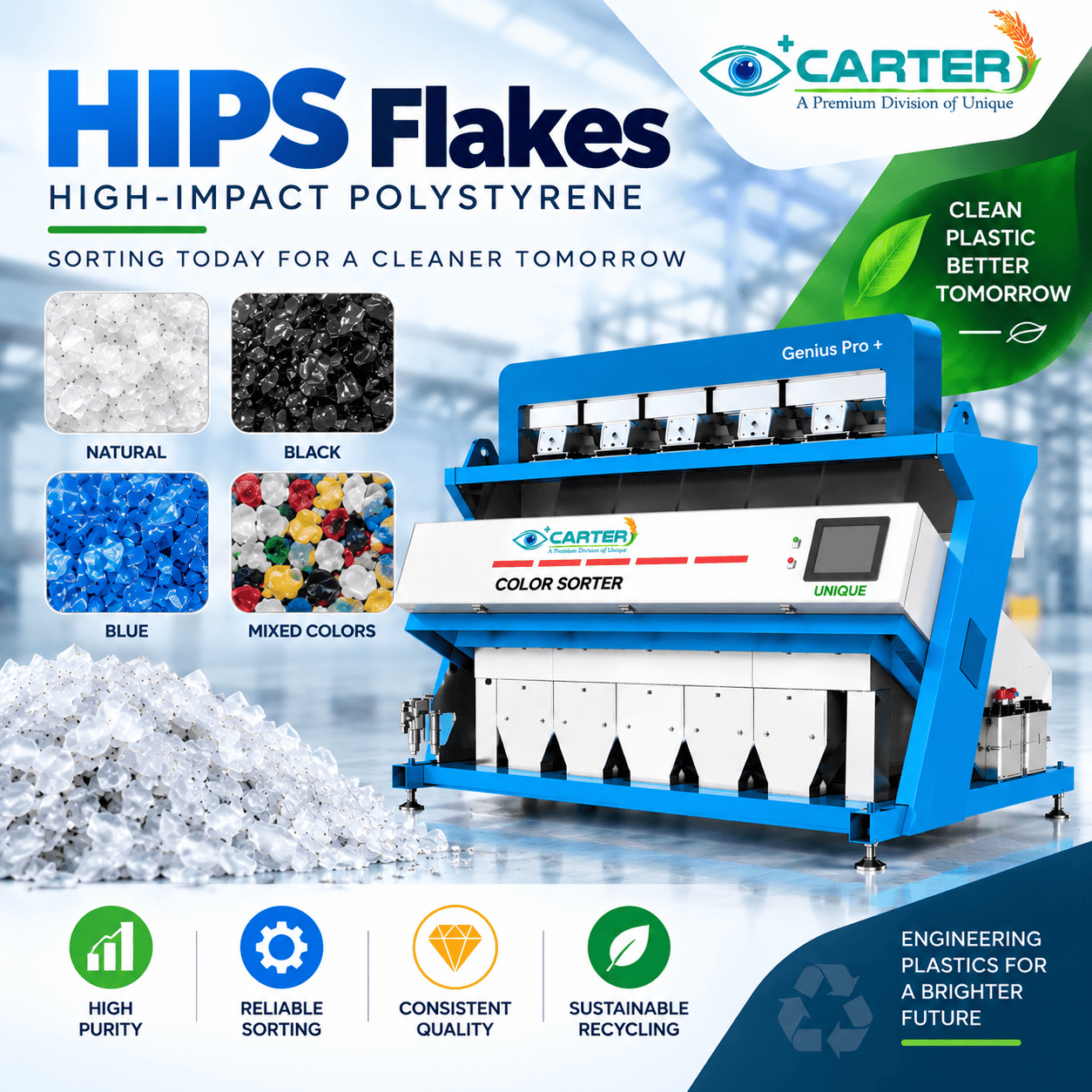
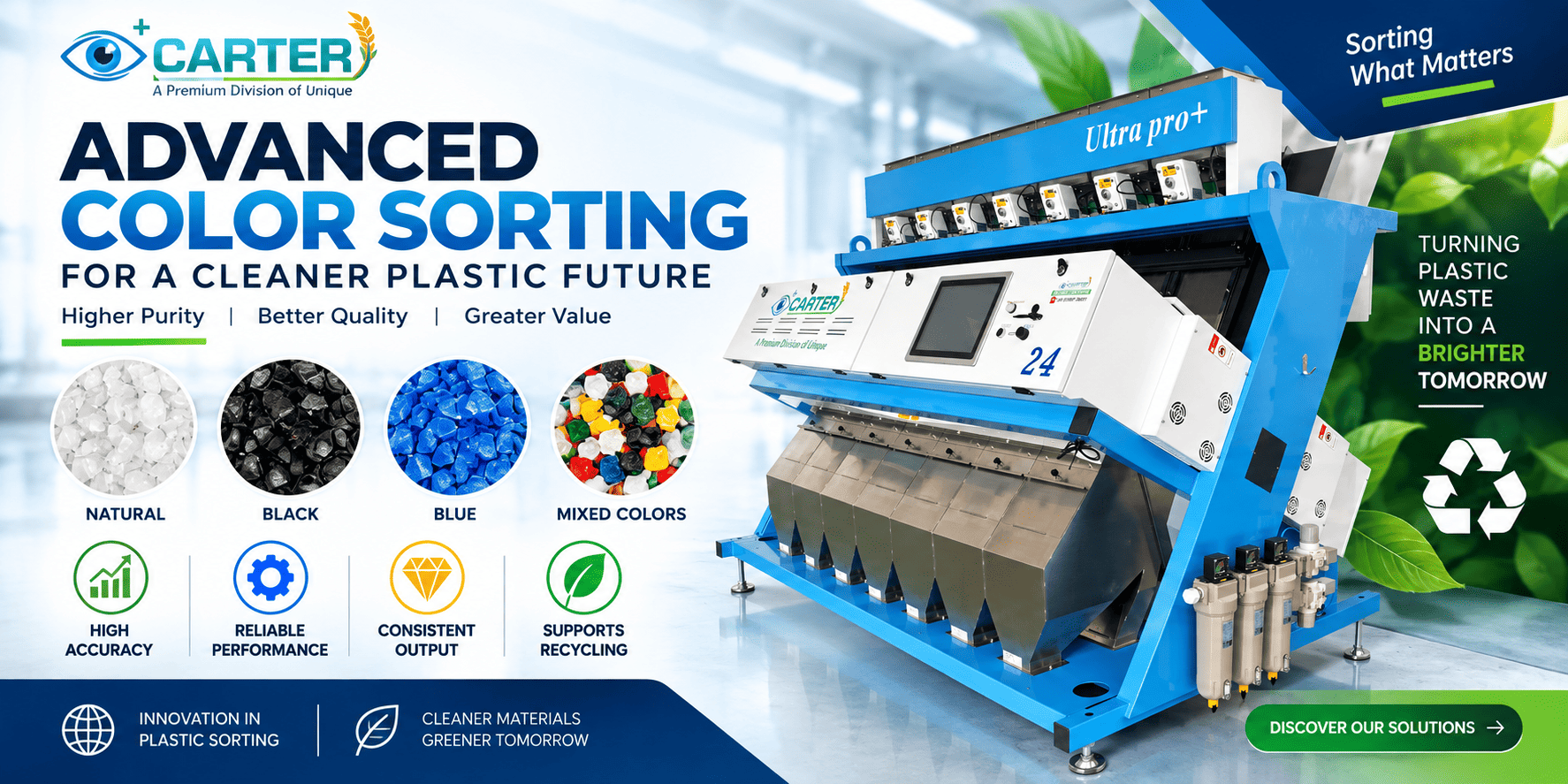
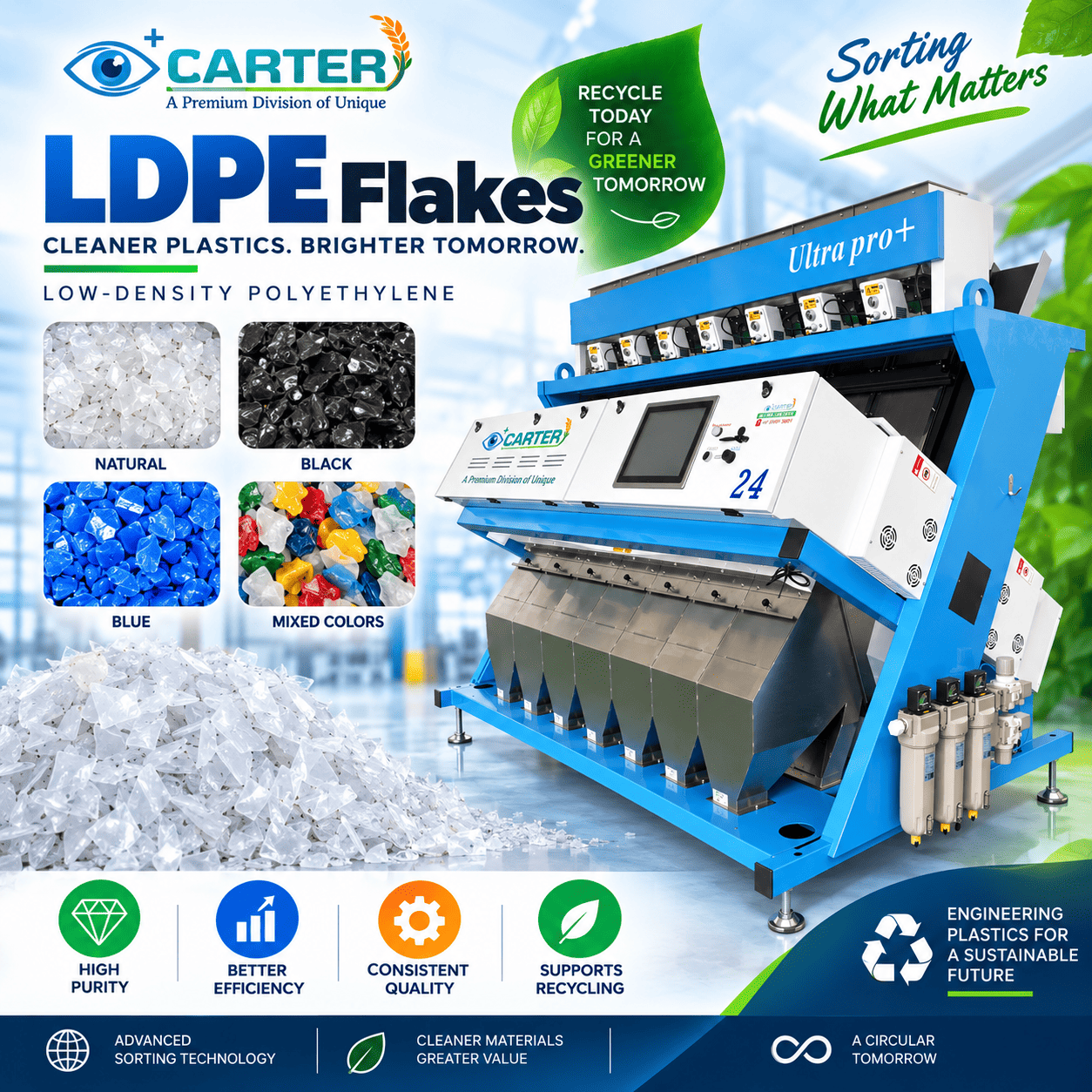
During PET recycling and granule production, maintaining consistent color and removing unwanted materials are essential for achieving better-quality output. A modern plastic color sorter machine can help automate the separation of PET granules or flakes according to color and optical characteristics.
For recyclers and plastic processors, advanced PET color sorting technology can improve material consistency, reduce manual sorting, and support more efficient recycling operations.
Polyethylene Terephthalate, commonly known as PET, is a thermoplastic polymer belonging to the polyester family.
PET granules are small pellet-shaped pieces of PET resin that can be processed into different plastic products. Depending on their source and grade, PET granules may be transparent, natural, white, blue, green, amber, or other colors.
PET granules can be produced from:
Manufacturers select different PET grades depending on the required properties and final application.
PET granules can broadly be classified according to their source, color, grade, and intended application.
Virgin PET granules are manufactured from newly produced polymer and are used where consistent material properties and controlled quality are required.
They are commonly used for packaging, bottles, films, sheets, and other applications.
Recycled PET granules are manufactured by collecting PET waste, sorting it, cleaning it, processing it, and converting it back into usable resin or pellets.
Recycled PET can be used in suitable applications depending on its quality and processing history.
Natural or clear PET granules are used when transparency or a light-colored finished product is required.
Colored PET granules contain pigments or colorants and may be produced in different colors according to customer requirements.
PET is widely used because of its combination of mechanical, thermal, and processing characteristics.
Important properties include:
The exact performance of PET depends on the polymer grade, additives, processing conditions, moisture content, and application.
PET granules are used in a wide variety of industries.
One of the largest applications of PET is packaging.
PET can be used to manufacture:
Its lightweight structure and useful barrier properties make it suitable for many packaging applications.
PET is also an important material for polyester fiber production.
Recycled PET can be processed into polyester fibers used in:
PET is used to manufacture various sheets and films for packaging, electronics, industrial applications, and other purposes.
Certain PET grades can be used for electrical insulation, films, components, and other applications requiring suitable electrical properties.
PET-based materials may be used in selected automotive applications where the material's mechanical and thermal characteristics meet the required specifications.
PET can also be used for:
The manufacturing process depends on whether PET is virgin or recycled.
For recycled PET granules, a typical process may include:
Collection → Sorting → Label & Contaminant Removal → Crushing → Washing → Separation → Drying → Extrusion → Filtration → Pelletizing → Quality Inspection
Let's understand the process.
PET waste is collected from post-consumer and post-industrial sources.
Common sources include discarded bottles, containers, sheets, and manufacturing waste.
Collected PET is sorted to remove unwanted materials.
Sorting may involve manual inspection, mechanical separation, optical sorting, and other technologies.
PET products are reduced into smaller pieces or flakes to make further processing easier.
The flakes are washed to remove:
PET flakes are separated from other materials and contaminants using suitable recycling technologies.
Moisture removal is particularly important before PET processing because moisture can affect the polymer during melting and processing.
The prepared PET material is melted and processed through an extruder.
Melt filtration can help remove remaining solid contaminants from the polymer melt.
The processed polymer is converted into small PET pellets or granules.
Depending on the product requirements, PET granules can undergo additional optical inspection or color sorting to improve consistency.
Color is an important quality characteristic in recycled PET.
Recycled PET streams can contain different colors such as:
If different colored particles are mixed together, they can affect the appearance and quality of the final product.
For example, a manufacturer producing clear or light-colored PET products may want to remove darker or differently colored particles.
This is where a plastic color sorter machine can provide an automated solution.
A plastic color sorter machine is an automated optical sorting system designed to detect and separate plastic particles according to color and other optical characteristics.
Depending on the machine configuration, sorting systems can use:
The system examines the material as it passes through the sorting area and separates particles that do not meet the selected sorting criteria.
For PET recycling, color sorting can be applied to suitable PET flakes, pellets, or granules.
A typical PET color sorting process works through several stages.
PET granules or flakes are fed into the machine through a controlled feeding system.
The material is distributed into an organized stream so individual particles can be inspected.
Cameras and sensors inspect the particles and detect differences in color and optical characteristics.
The machine's control system analyzes the detected information according to the selected sorting parameters.
When an unwanted particle is identified, a high-speed air-ejection system removes it from the accepted material stream.
Accepted PET material and rejected material are collected separately.
The actual sorting capability depends on the machine configuration, particle size, material preparation, color differences, contamination, and required output quality.
Automated color sorting can help create more consistent PET material streams.
Automated inspection allows continuous processing of suitable material streams.
The machine can reduce dependence on labor-intensive manual color inspection.
Removing unwanted colors and optical contaminants can improve the consistency of recycled PET.
Better color separation can be particularly valuable when recycled material is used in visible products.
Automated systems provide repeatable sorting based on configured parameters.
Efficient sorting helps recyclers recover and prepare valuable PET material for further processing.
PET is an important material in the global recycling industry.
However, collected PET waste can vary significantly in:
A modern PET recycling line therefore requires several stages of separation and quality control.
A plastic recycling color sorter can be incorporated into an appropriate recycling process to improve color separation.
For example, a recycling facility may separate:
Mixed PET → Clear PET → Blue PET → Green PET → Other Colors
This creates more consistent material streams for subsequent processing.
It is important to understand the difference between color sorting and polymer identification.
A color sorter machine primarily separates materials according to visible or detectable optical characteristics.
For example, it may separate:
However, if the requirement is to identify PET against other polymers such as PVC, PP, PE, or PS, color alone may not be sufficient.
Different plastics can have similar colors. In such applications, additional sensing or polymer-identification technologies may be required.
Therefore, businesses should clearly define whether they need color sorting, polymer separation, or both before selecting equipment.
PET bottle recycling can involve bottles of different colors, brands, labels, and contamination levels.
After shredding and washing, the resulting PET flakes can still have different optical characteristics.
Color sorting can help recyclers separate these streams into more consistent categories.
This can be particularly useful when producing recycled PET intended for applications where appearance and material consistency are important.
Selecting the correct plastic color sorter machine for PET requires consideration of several factors.
Determine whether the input material consists of:
The size and shape of PET particles can affect feeding and detection.
Identify the colors that need to be separated.
Evaluate the amount of contamination and unwanted material present in the feedstock.
Determine the required purity and color consistency of the final product.
Choose equipment suitable for the required production volume.
Different applications may require different optical, mechanical, and pneumatic configurations.
Installation, maintenance, spare parts, troubleshooting, and application support should also be considered.
A material sample test is strongly recommended before finalizing a machine because actual sorting performance depends on the characteristics of the specific PET feedstock.
Color consistency can have a major impact on the appearance of recycled plastic products.
For example, manufacturers producing clear or light-colored products may need highly consistent feedstock.
Unwanted colored particles can create visible variations in the finished product.
An effective sorting process can therefore help manufacturers produce more consistent recycled PET batches.
Automated sorting offers several advantages over purely manual inspection.
Continuous automated inspection can process material without relying entirely on manual sorting.
The machine applies programmed sorting parameters repeatedly.
Automation reduces the amount of manual inspection required.
Suitable sorting can help recover usable PET from mixed material streams.
Improved separation can support more efficient downstream processing.
India has a growing plastic processing and recycling industry, creating increasing demand for automated sorting technologies.
Working with an experienced plastic color sorter machine manufacturer in India can offer potential benefits such as:
When comparing a plastic color sorter machine manufacturer, businesses should evaluate machine technology, optical systems, sorting performance, construction quality, service support, and suitability for the specific PET material.
Carter Sorter Group offers sorting solutions for different material-processing applications, including plastic sorting.
For PET granules and suitable PET recycling streams, a plastic color sorter machine can help automate color separation and improve material consistency.
The ideal machine configuration depends on:
For businesses searching for a plastic color sorter machine manufacturer in India, application testing can help identify the appropriate sorting solution for their PET material.
Plastic recycling is increasingly moving toward automated and intelligent sorting systems.
Future sorting solutions are expected to focus on:
As demand for recycled PET increases, reliable separation and quality control will become increasingly important.
PET granules are small pellets of Polyethylene Terephthalate used as raw material for producing plastic products, packaging, fibers, films, and other applications.
A PET color sorter machine is an automated sorting system designed to identify and separate PET material according to color and detectable optical characteristics.
Yes. Suitable PET granules can be processed through a plastic color sorting machine, depending on particle size, color variation, feed quality, and machine configuration.
Yes. Color sorting can be incorporated into suitable PET recycling processes to separate different colored material streams and improve consistency.
Color sorting alone may not reliably identify every polymer. Additional sensing technologies may be required when the objective is polymer identification rather than color separation.
PET is widely used in packaging and other applications and can be collected and reprocessed into suitable recycled material, making efficient sorting and processing important for recycling operations.
Polyethylene Terephthalate (PET) granules are an important raw material for packaging, textiles, industrial products, films, sheets, and numerous other applications. PET offers a useful combination of strength, stiffness, dimensional stability, lightweight structure, and processing characteristics.
In recycled PET production, maintaining consistent material color and removing unwanted particles can improve the quality and appearance of the final material. A modern plastic color sorter machine can automate optical color separation and reduce the dependence on manual sorting.
For PET recyclers and granule manufacturers, selecting the right plastic color sorting machine requires careful evaluation of particle size, color variation, contamination, required output quality, and processing capacity.
For businesses looking for a plastic color sorter machine manufacturer in India, proper material testing and application-based machine selection can help achieve efficient and consistent PET sorting.
Copyright © 2025 Carter Unique Group, All Right Reserved.


.jpeg)


 Granules.png)
 Granules.png)
 Granules.png)

 Granules.png)
 Granules.png)