
Low-Density Polyethylene (LDPE) is a widely used thermoplastic known for its flexibility, lightweight nature, toughness, and resistance to moisture. It is commonly found in plastic films, bags, agricultural films, liners, flexible packaging, coatings, and various industrial products.
When LDPE waste is collected for recycling, it can be sorted, shredded or granulated, washed when required, dried, and processed into LDPE flakes. These flakes may contain different colors, shades, contamination, labels, and unwanted plastic materials. Automated sorting can therefore play an important role in preparing consistent material for further recycling.
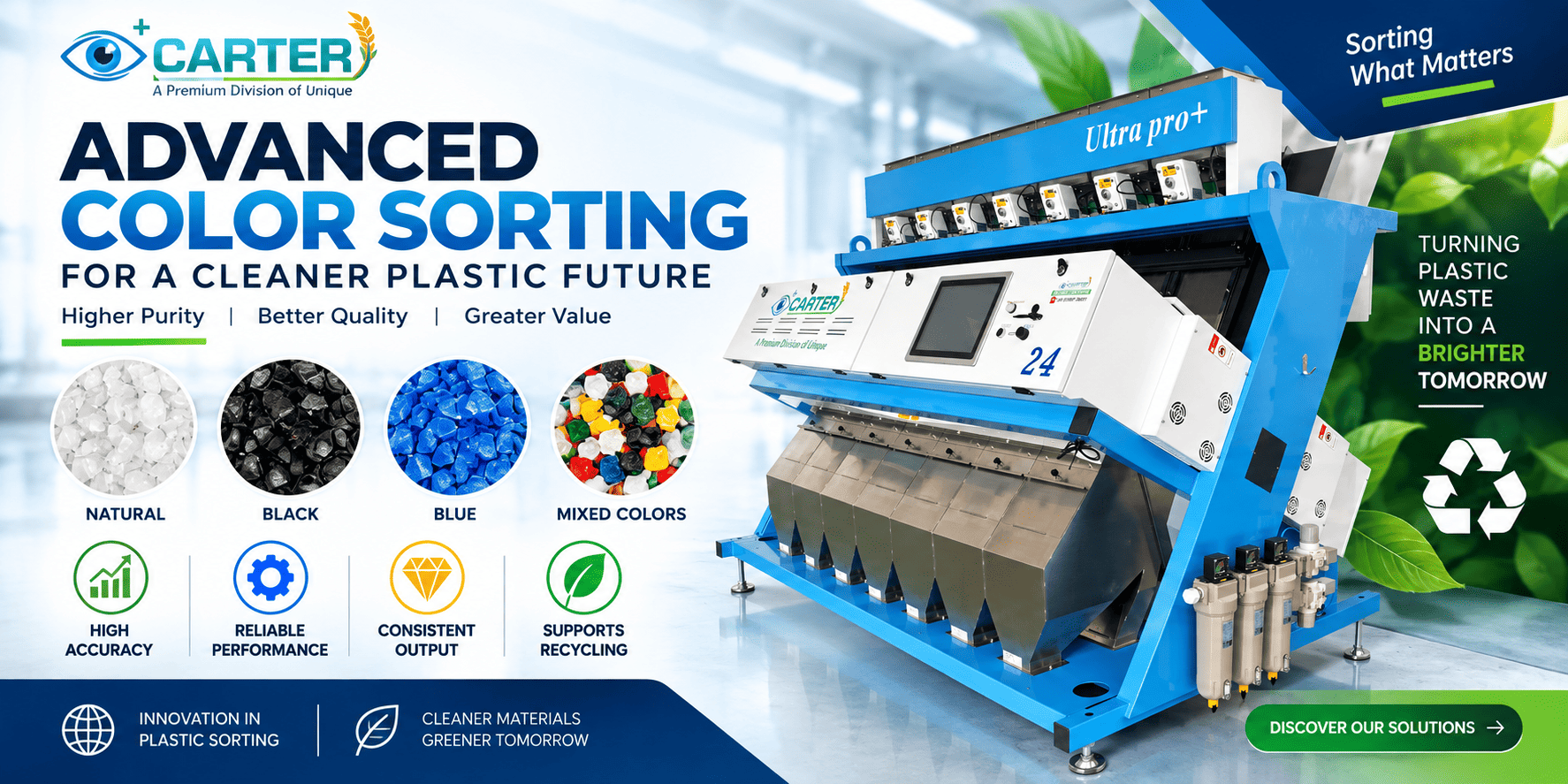
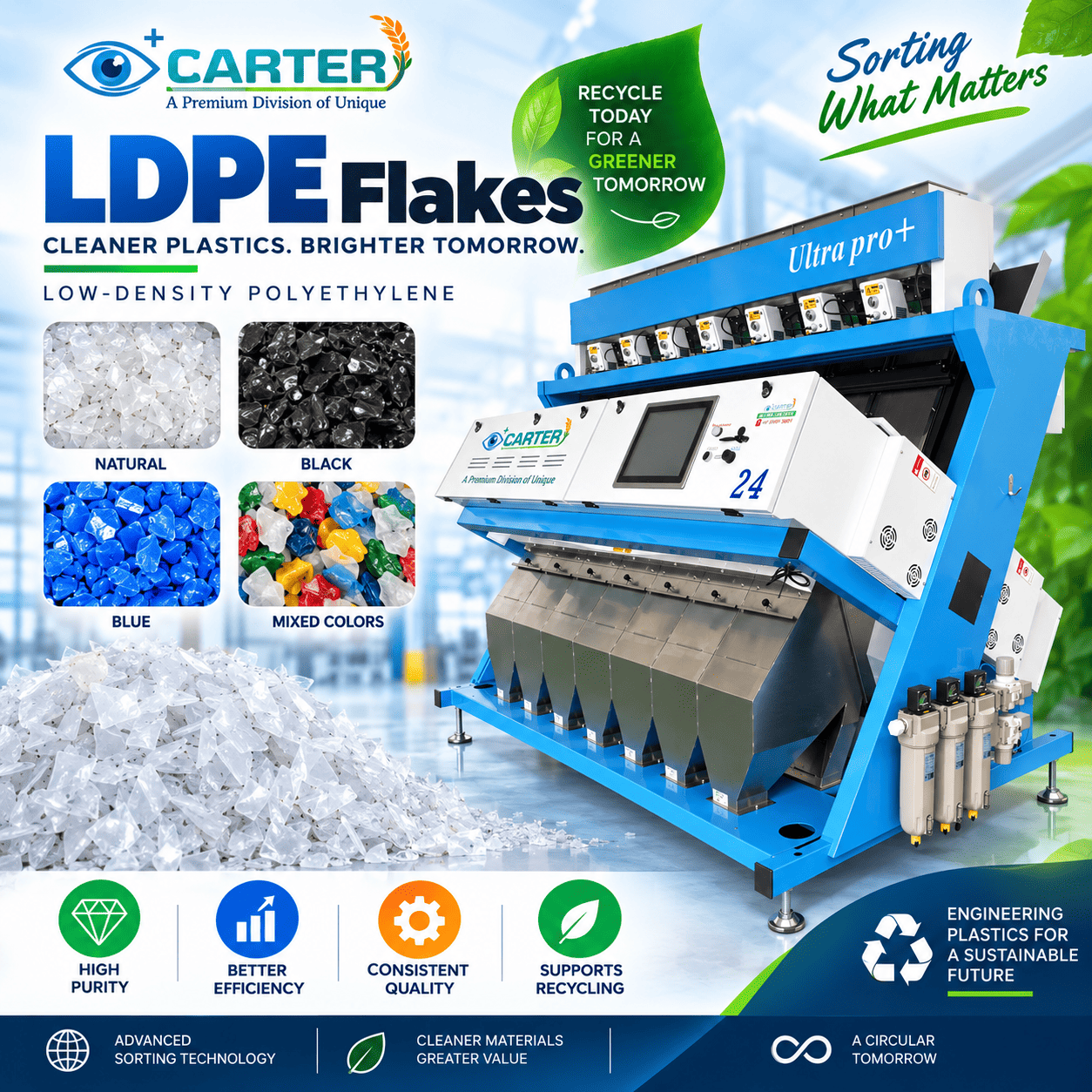
A Low-Density Polyethylene (LDPE) flakes color sorter machine uses optical sorting technology to identify detectable color and appearance differences and separate selected flakes from the material stream. For plastic recyclers, a plastic color sorter machine can help automate repetitive sorting operations and support more consistent recycled LDPE output.
LDPE flakes are small pieces of Low-Density Polyethylene generated during the recycling and processing of LDPE plastic waste.
LDPE waste can originate from:
After collection and preliminary sorting, the material may be processed through shredding, grinding, washing, drying, and screening. The resulting LDPE flakes can vary in size, color, cleanliness, and composition.
This variation makes proper sorting important for recycling operations targeting consistent feedstock.
LDPE is widely used because it combines flexibility with useful physical and chemical properties.
LDPE is relatively flexible compared with many other polyethylene grades, making it suitable for films, bags, sheets, and flexible packaging.
LDPE has a relatively low density, which contributes to its widespread use in lightweight plastic products.
LDPE provides good resistance to water and moisture, making it useful in packaging and protective applications.
LDPE can withstand bending and handling without easily becoming brittle under many normal conditions.
LDPE provides useful resistance to many common chemicals, although the exact resistance depends on the chemical, temperature, concentration, and material formulation.
LDPE can be processed using methods such as extrusion and film production, depending on the grade.
LDPE is used in many industries and everyday products.
LDPE is commonly used for:
LDPE films can be used for:
LDPE can be used in:
LDPE is also used in selected:
Recycled LDPE flakes can be used as feedstock for further recycling and processing when their quality is appropriate for the intended application.
Potential downstream applications include:
The actual application depends on the material's cleanliness, polymer composition, color, previous use, processing history, and required quality.
LDPE recycling streams can contain a wide range of colors.
For example, a recycling line may receive:
Natural + Transparent + White + Black + Blue + Green + Mixed Colors
If different colors are processed together, the resulting recycled material may have inconsistent appearance.
Manual color sorting can become difficult when large volumes of flakes need to be processed.
A LDPE flakes color sorter machine can help automate the separation of visually different material.
It can support:
A Low-Density Polyethylene (LDPE) flakes color sorter machine is an automated optical sorting system designed to detect and separate LDPE flakes based on detectable optical characteristics.
Depending on the machine configuration, the system may incorporate:
The basic operating principle is:
Feed → Detect → Analyze → Eject → Collect
As LDPE flakes move through the inspection area, the optical system identifies differences in appearance. When a flake matches the programmed rejection criteria, a high-speed air jet can eject it from the main product stream.
Prepared LDPE flakes are introduced into the machine through a controlled feeding system.
Stable feeding helps maintain consistent presentation to the optical inspection area.
The flakes move through a chute or sorting channel.
Proper presentation is important because overlapping or poorly positioned flakes can make optical detection more difficult.
Cameras and sensors inspect the material.
Depending on the system, the machine may detect differences in:
The sorting software analyzes the information captured by the optical system and applies programmed sorting criteria.
When an unwanted flake is detected, the relevant air ejector activates to remove it from the accepted material stream.
Accepted and rejected material are directed into separate outlets for further processing.
A typical LDPE recycling workflow may include:
LDPE Plastic Waste
↓
Pre-Sorting
↓
Shredding / Size Reduction
↓
Screening
↓
Washing Where Required
↓
Drying
↓
LDPE Flakes
↓
Optical Color Sorting
↓
Sorted LDPE Flakes
↓
Pelletizing / Further Processing
The exact process varies depending on the source and condition of the LDPE waste.
A color sorter can automate repetitive visual sorting tasks.
The system can separate visually different color fractions when sufficient optical contrast exists.
Automation can reduce dependence on continuous manual inspection.
Optical sorting systems can inspect material continuously as it passes through the sorting area.
Removing selected visually different material can help create more uniform fractions for downstream processing.
Sorting parameters can be adjusted according to the characteristics and objectives of the particular application.
Automated sorting can become an important component of a modern LDPE recycling operation.
An important consideration when selecting a plastic color sorter machine is understanding what color sorting can and cannot do.
A color sorter primarily detects optical differences.
It can therefore be useful for separating materials based on:
However, different polymers may have similar visual characteristics.
For example, LDPE can sometimes visually resemble other polyethylene or polyolefin materials. Therefore, color sorting alone should not be treated as a reliable method of polymer identification.
If a recycling operation needs to distinguish LDPE from other polymers with similar appearance, additional material-identification technology may be necessary.
Proper material preparation can contribute to stable sorting performance.
A suitable and reasonably consistent particle-size range helps with material presentation and optical inspection.
If the LDPE material has been washed, appropriate drying may be required before optical sorting.
Excessive dust can affect the sorting environment and material presentation.
LDPE film waste can behave differently from rigid flakes because of its flexible and lightweight nature. The feeding and preparation system should therefore be suitable for the actual material.
Overlapping flakes or film pieces can make optical inspection more difficult.
Paper, metal, labels, rubber, dirt, and other contaminants may require separate upstream or downstream separation processes.
Before purchasing an LDPE flakes color sorter machine, recyclers should evaluate their actual feedstock.
Determine whether the material comes from:
Determine whether the feed consists mainly of:
Identify the colors and shades present in the feedstock.
Check for:
The objective could be:
Sample testing is strongly recommended before final machine selection.
Testing actual LDPE material allows the machine supplier to evaluate the optical characteristics and determine whether the proposed sorting configuration is suitable.
LDPE film recycling presents specific handling considerations because films are flexible, lightweight, and can have large surface areas relative to their mass.
Film waste may also carry:
For this reason, the recycling line may require appropriate pre-processing before optical sorting.
Depending on the application, a combination of cleaning, drying, size reduction, screening, and optical sorting may be used.
A plastic color sorter machine can then be considered as one stage for color-based separation.
India has a large plastics processing and recycling sector, creating demand for automated sorting equipment.
Working with a plastic color sorter machine manufacturer in India can provide access to:
For LDPE recycling, the machine should be selected according to the actual feedstock rather than relying only on general plastic-sorting specifications.
Carter Sorter Group provides sorting solutions for plastic-processing and recycling applications.
Its plastic color sorter machine solutions can be considered for plastic flakes and granules where automated optical color separation is required.
For LDPE flakes, the appropriate machine configuration depends on factors such as:
For a specific LDPE recycling application, representative material testing can help determine the appropriate sorting approach.
Plastic recycling is increasingly adopting automated sorting and material-recognition systems.
Future recycling lines may combine multiple technologies, including:
For mixed flexible-plastic waste, combining color sorting with material identification can provide a broader approach to material separation.
Color sorting can be considered after suitable film preparation when the recycling process requires separation based on visible color.
Mixed-color packaging waste can potentially be separated into more consistent fractions depending on the material characteristics.
Agricultural films can contain significant contamination. Cleaning and preparation are particularly important before optical sorting.
Post-industrial LDPE waste may offer more consistent material characteristics, depending on the source.
When LDPE is mixed with other flexible polymers, color sorting may help with visual separation, but polymer identification may require additional technology.
LDPE flakes are small pieces of Low-Density Polyethylene produced by processing LDPE plastic waste.
It is an optical sorting machine designed to separate LDPE flakes according to detectable color and optical differences.
Yes. When sufficient color or optical contrast exists, a color sorter can separate different color fractions.
Not reliably based on color alone. Polymer identification may require additional material-recognition technology.
It can be considered, but film requires appropriate preparation and feeding because of its flexible and lightweight characteristics.
The practical sorting capability depends on the actual colors, shades, material size, surface condition, and machine configuration.
Not necessarily. The required preparation depends on the source and contamination. If washing is performed, suitable drying may be needed.
Sample testing is recommended because LDPE waste varies significantly in color, size, contamination, and composition.
Low-Density Polyethylene (LDPE) flakes are an important recyclable material generated from films, bags, packaging, agricultural products, liners, and other flexible plastic applications.
Because LDPE recycling streams can contain multiple colors and visually different materials, automated optical sorting can help improve the consistency of recycled fractions. A Low-Density Polyethylene (LDPE) flakes color sorter machine uses optical detection, image processing, and pneumatic ejection to separate detectable color differences.
For plastic recyclers, a plastic color sorter machine can reduce repetitive manual sorting and support continuous optical inspection. However, the appropriate solution depends on the actual LDPE feedstock, especially when dealing with flexible films.
Material sample testing before final machine selection is recommended to determine whether the proposed optical sorting configuration is suitable for the specific LDPE recycling application.
Copyright © 2025 Carter Unique Group, All Right Reserved.


.jpeg)


 Granules.png)
 Granules.png)
 Granules.png)

 Granules.png)
 Granules.png)