
High-Impact Polystyrene (HIPS) is a modified form of polystyrene designed to provide better impact resistance than standard polystyrene. It is widely used in consumer products, packaging, appliances, electronics housings, automotive components, and various industrial applications.
During plastic recycling, HIPS waste can be shredded and processed into HIPS flakes. These flakes may contain different colors, shades, contaminants, and unwanted plastic pieces. Effective sorting is therefore important for recyclers who need consistent and visually uniform recycled material.
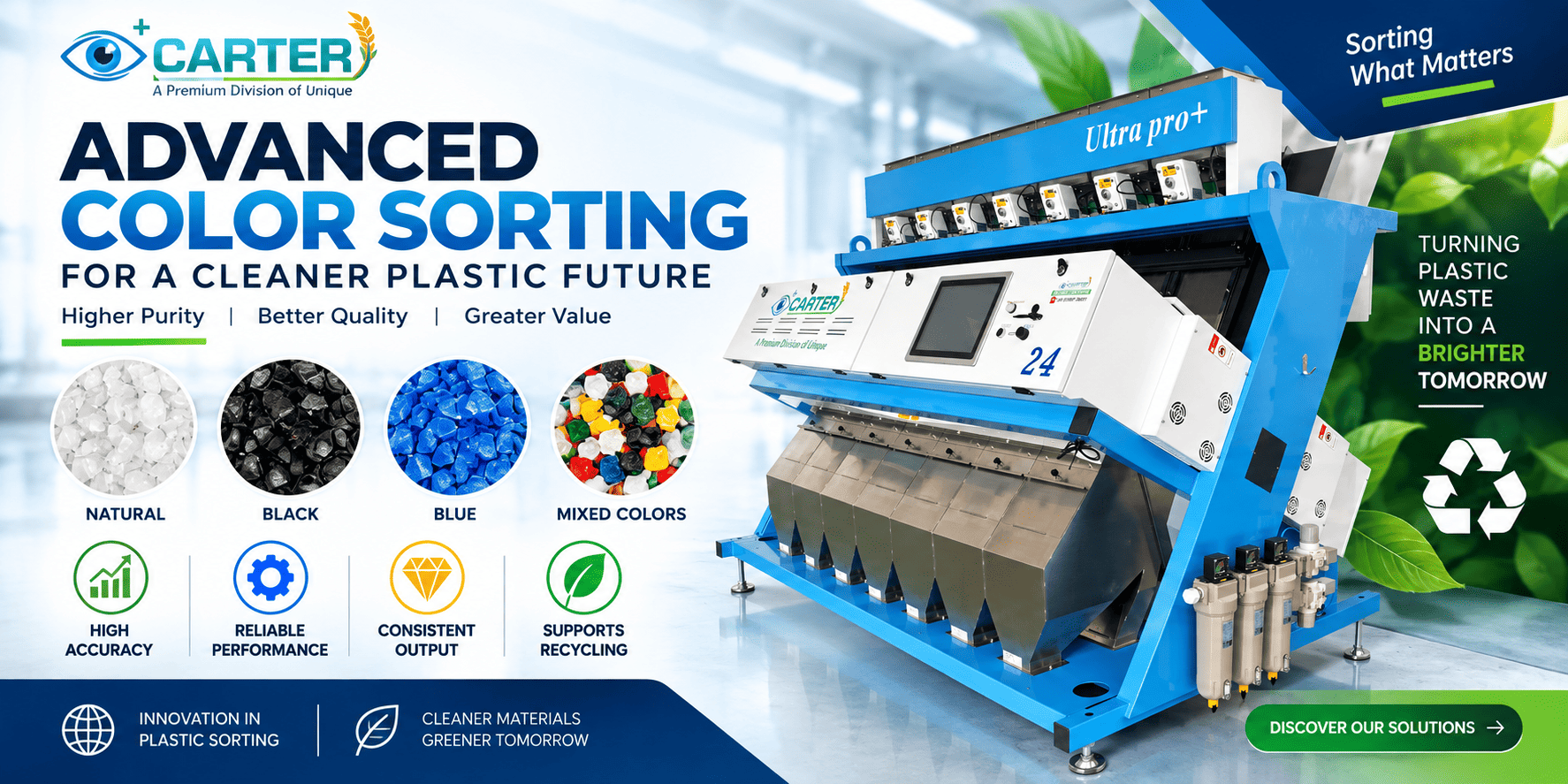
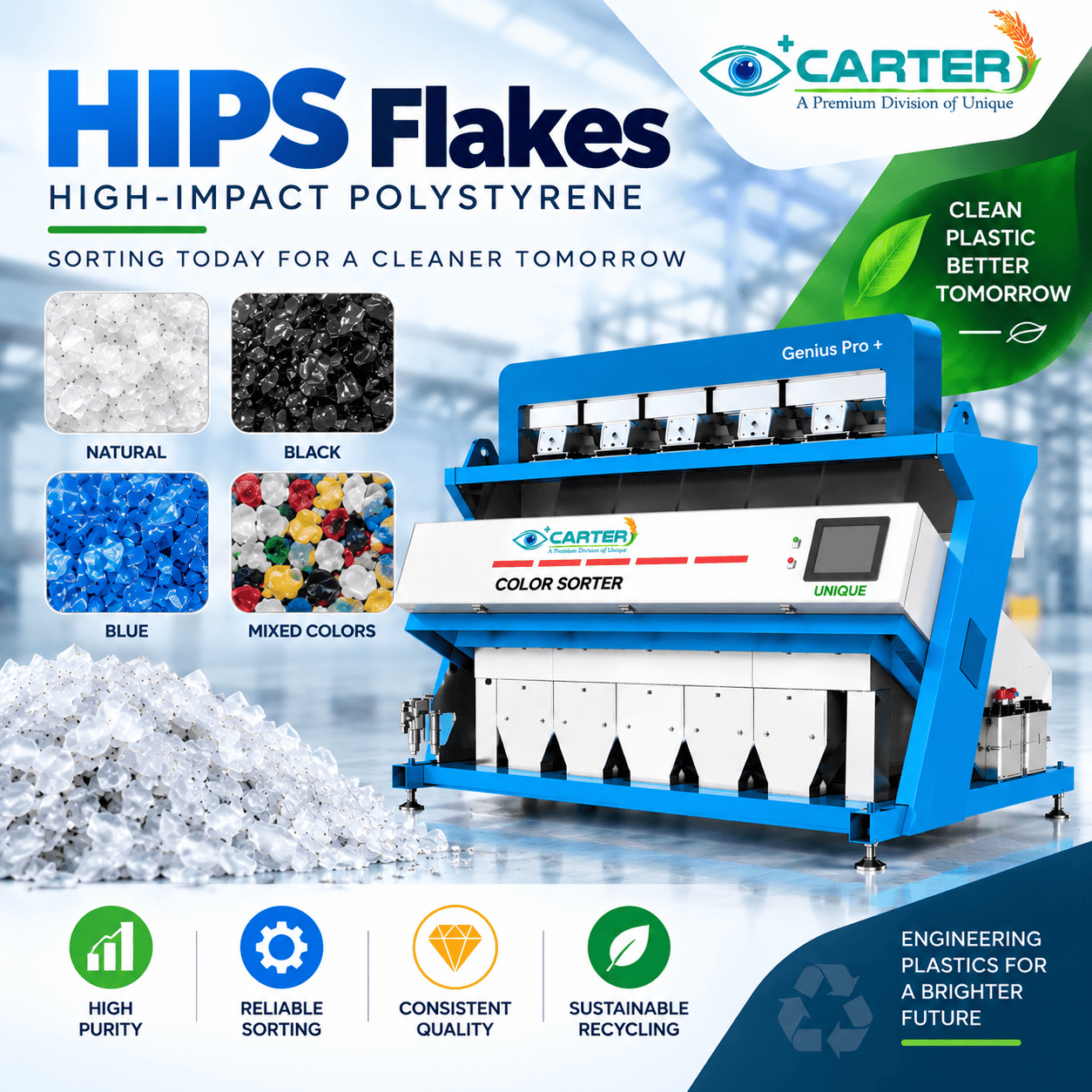
A HIPS flakes color sorter machine can automate the separation of flakes based on detectable color and optical differences. By reducing repetitive manual sorting and providing continuous optical inspection, a plastic color sorter machine can support more efficient HIPS recycling operations.
High-Impact Polystyrene (HIPS) is a polystyrene-based thermoplastic modified with a rubber component, commonly polybutadiene, to improve its impact resistance.
When HIPS plastic waste is collected and processed for recycling, it can be:
The resulting HIPS flakes are small pieces of recycled HIPS material that can potentially be used as feedstock for further processing, depending on their quality, composition, contamination, and end-use requirements.
HIPS flakes can vary considerably in:
This variation creates a need for effective sorting technology.
HIPS is developed to provide a balance between the rigidity of polystyrene and improved impact resistance.
Compared with general-purpose polystyrene (GPPS), HIPS is modified to withstand impact more effectively.
HIPS maintains useful rigidity for applications requiring a relatively stiff plastic material.
HIPS can be processed using techniques such as injection molding and extrusion, depending on the grade and application.
Suitable HIPS grades can provide an attractive surface finish, making the material useful for visible consumer and industrial products.
Like other polystyrene-based materials, HIPS has a relatively low density compared with many engineering plastics.
Its combination of processability, stiffness, impact performance, and appearance makes HIPS useful across multiple industries.
HIPS and General-Purpose Polystyrene (GPPS) are related materials but have different characteristics.
| Feature | HIPS | GPPS |
|---|---|---|
| Base polymer | Polystyrene | Polystyrene |
| Modification | Rubber modified | Generally unmodified |
| Impact resistance | Higher | Lower |
| Appearance | Often opaque | Can be transparent |
| Typical use | Housings, packaging, appliances | Packaging, transparent products, containers |
| Recycling considerations | May require dedicated sorting | Material identification may be necessary |
An important point for recyclers is that color sorting does not automatically distinguish HIPS from GPPS when the materials have similar visual characteristics. Polymer identification may require additional technologies.
HIPS is used in many commercial and industrial products.
HIPS can be used in:
HIPS is used for selected:
HIPS is widely associated with applications in appliances where stiffness, impact performance, processability, and appearance are required.
HIPS can be used in various packaging applications and disposable products, depending on the grade.
Selected HIPS grades and blends can be used in automotive interior and other components where the material's properties are appropriate.
HIPS can also be found in:
Recycled HIPS flakes can serve as feedstock for further processing when their quality meets the requirements of the intended application.
Potential uses include:
The actual end use depends on the polymer composition, color, contamination, previous processing history, and quality requirements.
HIPS recycling streams can contain multiple colors.
For example, a recycling facility may receive:
Natural + White + Black + Grey + Blue + Mixed Colors
If these materials are processed together, the resulting recycled material may have inconsistent color.
Manual sorting can be time-consuming, especially when the volume of flakes increases.
A HIPS flakes color sorter machine can help automate this process.
Color sorting can help with:
A HIPS flakes color sorter machine is an optical sorting system designed to detect and separate HIPS flakes according to detectable optical characteristics, particularly color and shade.
The system generally combines:
The basic process can be summarized as:
Feed → Detect → Analyze → Sort → Collect
As HIPS flakes pass through the inspection area, the optical system analyzes them. When a flake matches a programmed rejection condition, the corresponding air jet can remove it from the primary material stream.
Prepared HIPS flakes are introduced into the machine through a controlled feeding system.
Consistent feeding helps maintain stable material presentation.
The material travels through the sorting area in a controlled stream.
Individual flakes need to be presented clearly enough for the optical system to inspect them.
Cameras and optical sensors examine the material.
Depending on the system, detectable differences can include:
The sorting software evaluates the information captured by the optical system.
The programmed sorting criteria determine which material should remain in the accepted stream and which should be rejected.
When an unwanted flake is detected, a high-speed air jet can eject it from the material stream.
Accepted and rejected material are collected separately for further processing.
A typical recycling workflow may look like this:
HIPS Plastic Waste
↓
Sorting / Pre-Separation
↓
Shredding
↓
Screening
↓
Washing & Drying Where Required
↓
HIPS Flakes
↓
Optical Color Sorting
↓
Sorted HIPS Flakes
↓
Further Recycling / Pelletizing
The exact recycling process varies according to the source and quality of the incoming plastic.
Automated optical sorting reduces dependence on continuous manual inspection.
Different color fractions can be separated when the optical differences are sufficiently detectable.
A properly configured sorting system can inspect material continuously as it passes through the machine.
Automation can reduce repetitive sorting tasks and allow operators to focus on other stages of the recycling process.
Removing visually different unwanted flakes can help create more consistent material for downstream processing.
The sorting system can be configured according to the material characteristics and desired separation objectives.
Efficient sorting is an important part of recovering useful plastic material from waste streams.
This is particularly important when sorting HIPS.
A plastic color sorter machine primarily identifies detectable optical differences. It is therefore useful for separating material according to color and appearance.
However, different polymers can have similar colors.
For example:
may sometimes appear visually similar.
Therefore, a color sorter should not automatically be treated as a polymer-identification machine.
If a recycling operation needs to distinguish HIPS from another polymer with a similar appearance, additional material-identification technology may be required.
The quality of the incoming material can significantly affect optical sorting.
A consistent and suitable particle-size range helps provide better material presentation.
Excessive dust can make the sorting environment less favorable and may affect optical inspection.
If washing is part of the recycling process, appropriate drying may be necessary before optical sorting.
Flakes that overlap each other can make optical detection more difficult.
Paper, metal, rubber, labels, and other contaminants may require separate upstream or downstream separation processes.
Before purchasing a HIPS flakes color sorter machine, recyclers should consider the actual characteristics of their material.
Determine whether the feed consists of:
Measure the approximate minimum and maximum particle sizes and discuss them with the machine manufacturer.
Identify the colors and shades present in the material.
Determine whether the feed contains:
The requirement could be:
Sample testing is highly recommended before final machine selection.
Testing actual HIPS flakes allows the manufacturer and recycler to assess how effectively the optical system can distinguish the required material under real conditions.
India has a large and growing plastics processing and recycling sector, creating demand for automated sorting equipment.
Working with an experienced plastic color sorter machine manufacturer in India can provide access to:
For HIPS recycling, the supplier should understand the specific feed material rather than recommending a machine based only on general plastic-sorting requirements.
Carter Sorter Group provides color sorting solutions for plastic-processing and recycling applications.
A plastic color sorter machine can be considered for applications involving plastic flakes and granules where color-based optical separation is required.
For HIPS flakes, the suitable machine configuration depends on factors such as:
Carter Sorter Group can evaluate the application based on representative material samples and help determine an appropriate sorting configuration.
The future of plastic recycling is moving toward increasingly automated material-recognition and sorting systems.
Color sorting can be combined with other technologies to address more complex recycling requirements.
Potential technologies include:
For mixed plastic waste, combining color sorting with material-identification technologies can provide a more comprehensive approach than relying on color alone.
HIPS flakes are small pieces of High-Impact Polystyrene obtained after processing HIPS plastic waste through shredding or recycling operations.
It is an optical sorting machine designed to separate HIPS flakes based on detectable color and optical differences.
Yes. When the color differences are sufficiently detectable, a color sorter can separate different color fractions of HIPS flakes.
Not reliably based on color alone. When polymers have similar optical appearances, additional polymer-identification technology may be necessary.
The practical sorting capability depends on the actual colors, shades, particle size, surface condition, and machine configuration.
Real-world HIPS recycling material can vary considerably. Sample testing helps determine whether the selected optical sorting system is suitable for the specific feedstock.
Yes. An automated color sorter can reduce repetitive manual visual sorting by continuously inspecting and separating material.
It can be useful for color-based separation, but mixed-polymer identification may require additional sorting technologies.
High-Impact Polystyrene (HIPS) flakes are an important recyclable plastic feedstock used in a variety of consumer, appliance, electronics, packaging, automotive, and industrial applications.
During recycling, differences in color and appearance can make automated optical sorting useful. A HIPS flakes color sorter machine can inspect material continuously and separate detectable color variations using optical detection and pneumatic ejection.
For recyclers looking to improve the consistency of HIPS flakes, a plastic color sorter machine can become an important part of an automated recycling line. However, machine selection should always consider the actual flake size, colors, contamination, feed composition, and required output.
Testing representative HIPS flakes before selecting the final machine configuration is recommended for achieving a sorting solution suited to the specific application.
Copyright © 2025 Carter Unique Group, All Right Reserved.


.jpeg)


 Granules.png)
 Granules.png)
 Granules.png)

 Granules.png)
 Granules.png)